Showing posts with label Pesticides & Insecticides. Show all posts

Chatham County NC November 2022 Household Hazardous Waste Event

November 2022 Chatham County NC Household Hazardous Waste Event

The September Household Hazardous Waste (HHW) event  will be Saturday, November 19 from 9:00 am to 3:00 pm. HHW events are a way for residents to dispose of hazardous materials safely. Decals are not required, but residents will need to show their NC Driver License or something with their current address. HHW is only for households; no hazardous waste from businesses will be accepted.

At HHW events, the county accepts such items as oil-based paints, solvents, stains, bleach, aerosols, cleaners, pesticides, brake fluid, fluorescent light bulbs, propane tanks, etc. Residents can bring 20 gallons of latex paint cans per HHW event. If you have a 1 gallon paint can that has half a gallon of paint in it, it will count as 1 gallon. Latex paint can be safely dried out and put in with your regular trash.

For a complete list, please visit the www.chathamcountync.gov/hhw or contact the Solid Waste & Recycling Division at 919-542-5516 or recycle@chathamcountync.gov.

HHW events are held the third Saturday of each month March through November.

2022 Summer Tours of NC Cooperative Extension Pollinator Demonstration Garden in Pittsboro Start in July

Summer tours of North Carolina Cooperative Extension’s Pollinator Paradise Demonstration Garden in Pittsboro start in early July!

The garden features over 225 species of perennials, trees, shrubs, vines, and grasses, and 85% of them are native to North Carolina. This is a great opportunity to visit the popular gathering spot for honey bees, native bees, butterflies, hummingbirds, and beneficial insects in addition to their human admirers! The tours are led by Chatham County Agriculture Agent Debbie Roos.

There is no charge for the tour but registration is required to limit group size. The tours fill up very quickly so don’t delay in registering if you really want to attend.

Visit the Pollinator Garden Tour web page for a listing of tour dates and times and links to register. 


The Pleasures of Summer Moth Watching

The Pleasures of Moth-Watching

Summer isn't just butterfly season and tomato season, it's also high moth season. And while you may think that a moth garden doesn't sound quite as enchanting as a butterfly garden, I beg to differ. Thanks to guidance from some patient experts, these days you can call me the moth gardener.

Light pollution at night is a major killer of insects, particularly moths, contributing to global insect decline, so if you have security lights, operate them on a motion sensor, or switch bulbs to yellow LEDs, which are less attractive to insects.

Rocky River Watch Sues Over Water Pollution

Rocky River Watch sues over water pollution/Rocky River Watch demanda por la contaminación del agua

For the Spanish version, scroll to the bottom/Para la versión de español, desplácese hacia abajo Loves Creek and Rocky River in Chatham County once was subject to nutrient pollution from two chicken processing plants. They have since begun to recover, but discharges from a new chicken plant might change that.

How the Lawn Took Over American Life and Created An Environmental Nightmare

American Green

Ted Steinberg | American Green | W. W. Norton & Company | March 2006 | 43 minutes (7,070 words) Although there are plenty of irrational aspects to life in modern America, few rival the odd fixation on lawns. Fertilizing, mowing, watering - these are all-American activities that, on their face, seem reasonable enough.

What You Need to Know About Organic Broadleaf Weed Control

What You Need to Know About Organic Broadleaf Weed Control

If you want a chemical-free landscape and also want to defeat lawn weeds, the best defense is prevention. But weed prevention can take some time and, on occasion, you may need herbicides. Organic herbicides are a viable option for weed removal today, with more than 30 on the U.S. market.

Proposed Secret Chemical Treatment of Jordan Lake Could be Dead in the Water

Proposed secret chemical treatment of Jordan Lake could be dead in the water | NC Policy Watch

This is the first of two stories about Jordan Lake. Tomorrow read about the UNC Collaboratory's findings on algae and pollution in the reservoir. It seemed like a bad idea at the time. Now, confirming the concerns of many scientists, environmental advocates and even some lawmakers, a plan to chemically treat a portion of Jordan Lake is even worse.

Did Monsanto Ignore Evidence Linking Its Weed Killer (Roundup) to Cancer?

Did Monsanto Ignore Evidence Linking Its Weed Killer to Cancer?

The public brawl couldn't come at a more pivotal moment. Monsanto is currently pursuing a mega-merger with the German chemical giant Bayer AG, a $66 billion deal that still has to be approved by American and German antitrust regulators. The EPA's latest safety assessment of glyphosate is expected soon, and the European Union is also deliberating whether to relicense its use.

Jordan Lake One Water Association -- A New Collaboration

Jordan Lake One Water Association: A New Kind of Collaboration

The Jordan Lake watershed is a massive regional resource utilized by 10 counties, 27 municipalities and nearly 700 water customers (see Figure below), and is continuing to be more populous every day. As challenges with water quality and water supply increase from growing populations, it is imperative that water resources dialogue span across jurisdictional bounds.

Cape Fear River Forums Aim to Educate and Inspire Citizens in NC’s Largest and Most Industrialized Watershed

Upper Sub-basin Forum:
September 26, 2017 from 4:00 PM - 6:00 PM
Elon University, Moseley Center, 2nd Floor Room 215 100 Campus Dr, Elon, NC
MAP/Directions

All residents of the Cape Fear River Basin and their elected officials are invited to the Cape Fear River Forums September 26-28th. The Cape Fear River Assembly is hosting its first annual Regional Forum series to educate and engage participants in a basin-wide discussion on the importance of the Cape Fear River. The Cape Fear River system is North Carolina’s largest river system whose basin covers 9,000 square miles and encompasses streams in 29 of the state’s 100 counties and is the most industrialized of all of North Carolina’s rivers.

The Cape Fear is our main source of drinking water and industrial water. Continuing growth and competing demands for water use across the basin make it more important than ever to engage the community on these topics. Citizen and local government awareness, interest, and concern about the Cape Fear River is critical and increasing.

The Cape Fear River winds for 200 miles through the heart of the North Carolina Piedmont, crossing the coastal plain, and emptying into the Atlantic Ocean near Southport. The 35 miles of river between Wilmington and the ocean is called the Cape Fear Estuary because of the tidal influence and saline waters. This area of the river is extremely important for saltwater animals because of its function as a nursery for juvenile fish, crabs, and shrimp. In addition to providing a habitat for fish and other aquatic animals, the wetlands surrounding the Cape Fear Estuary are home to otters, alligators, a host of bird species and even bears.

The Cape Fear River Forums will be held in each of the key subbasins (upper, middle and lower) and will address water issues, industry, and environmental solutions. Each forum is free and open to the public.

Dr. Erin Eldridge, professor of Anthropology at Fayetteville State University will present a poster on coal ash contamination of drinking water.  Sustainable Sandhills will present a poster highlighting local climate resilience efforts. The North Carolina Wildlife Resources Commission will display a variety of posters on their Green Growth Toolbox, state of fisheries, the Atlantic Coast Pipeline and more. Various universities, including NCSU, ECU and UNCW will present research on water quality and supply. The Cape Fear River Partnership will share their 5-year Implementation Plan.  Other posters will be presented on topics ranging from water quality concerns like GenX and CAFOs, to flooding and stormwater, agriculture, wildlife, green growth and best management practices, the Atlantic Coast Pipeline, Jordan Lake, and more.  All posters will highlight issues and solutions relevant to the Cape Fear on a local and regional scale.

The Cape Fear River forums will see the launch of the Cape Fear River Video Project.  Willing participants will have the opportunity to share local community insights and reactions to issues confronting the river.  Carter Media Consulting will be on hand to record the stories, thoughts, and concerns of attendees related to the Cape Fear River.

Other Locations and Dates:
  • Middle Sub-basin Forum: Fayetteville, NC September 27, 2017 from 4:00 PM - 6:00 PM. Fayetteville State University, Lyons Science Annex (LSA), Rooms 120/121 1200 Murchison Road, Fayetteville, NC (off of W.T. Brown Dr.)
  • Lower Sub-basin Forum: Wilmington, NC September 28, 2017 from 4:00 PM - 6:00 PM. UNC Wilmington, Center for Marine Science, Main Auditorium 5600 Marvin K. Moss Lane, Wilmington, NC
Agenda:

4:00PM - 4:45PM
Welcome
Cape Fear River Assembly Presentation
River Issues in Your Area

4:45PM - 6:00PM
Experts/Community Posters Introduction
Cape Fear Video Project
Poster Social Hour and Light Refreshments

About the Cape Fear River Assembly
The Cape Fear River Assembly (CFRA) is an independent nonprofit with a mission to provide the highest quality of life possible for the residents of the Cape Fear River Basin, through the proper management of the Cape Fear River, its tributaries, and adjacent land uses. This mission is accomplished through efforts to investigate, educate and effectuate. Scientific study coupled with economic analyses will provide the information needed to make the best possible decisions regarding this river system and its uses. Education provides a better-informed public and thereby improved stewardship of the river system as a resource. 

The CFRA includes membership from Greensboro and High Point to Wilmington with a 39 member Board of Directors.  The Assembly membership and the board are made up of representatives from throughout the Cape Fear River Basin and with varying interests including environmental and conservation organizations, academia, small business and industry, government (local, state, and federal), and the general public.

FHA & The Green Scene: 4-In-One Community Recycling Event

FHA In Partnership With 
The GREEN SCENE
Saturday, May 20, 2017 9:00am to Noon

Fearrington Village and Galloway Ridge Residents Only

4 Events--1 Day: Gathering Place Parking Lot. Have coffee with your neighbors!

1. FREE SHREDDING

Have your confidential documents destroyed on site, free of charge. Watch as Shimar Recycling Inc. shreds your documents.

Guidelines:
  • Bound paper stacks one inch thick or more need to be separated 
  • Remove rubber bands and heavy banker's paper clips from papers 
  • Paper should not be in binders or heavy plastic.

    For more information, contact: the FHA Office at The Gathering Place Monday-Friday 9:00am - Noon. Phone: 919-542-1603. Email: office@fearringtonfha.org.

    2. HAZARDOUS HOUSEHOLD WASTE DROP-OFF EVENT

    This will be a drive-through operation provided by ECO-FLO and Green Scene volunteers. Put containers inside a cardboard box or a reusable bin lined with newspaper. Do not mix the products together and leave products in their original containers with labels intact. Put in the trunk of your vehicle. We will remove items from your vehicle.

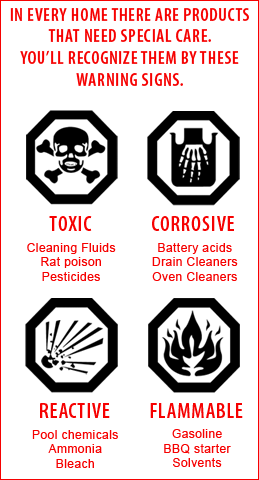
    HAZARDOUS WASTE that will be accepted includes anything that is corrosive, reactive, toxic or ignitable (examples: Paint, Pesticides, Batteries, Herbicides, Oven Cleaner, Fluorescent Bulbs).

    Please Do NOT Bring: asbestos, explosives, infectious waste or radioactive materials.

    For more information, contact: the FHA Office at The Gathering Place Monday-Friday 9:00am - Noon. Phone: 919-542-1603. Email: office@fearringtonfha.org.

    3. PRESCRIPTION MEDICINE DISPOSAL

    The Chatham County Sheriff’s Department will be available to safely dispose of all your old, unused, or expired prescription medications safely and legally.

    All you need to do is leave them in the original packaging and hand them to the sheriff deputy on duty at the Gathering Place. No liquid medication or "sharps" (needles) are accepted. We will also provide information on-site for those who may be interested in donating Remember: NEVER FLUSH medicines as they cause environmental issues.  For more information, contact: the FHA Office at The Gathering Place Monday-Friday 9:00am - Noon. Phone: 919-542-1603. Email: office@fearringtonfha.org.
    AN ALTERNATIVE TO THROWING AWAY YOUR CURRENT UNUSED, UNWANTED PRESCRIPTION MEDICINES:
    consider donating them to Chatham Cares Community Pharmacy [CCCP] in Siler City, a non-profit community based organization operated by a licensed pharmacist and committed to reducing health disparities by providing access to quality pharmacy services to the low-income, uninsured, and underinsured residents of Chatham County. Read all about it here.

    FireExtinguisherABC1

    4. FIRE EXTINGUISHER CHECK

    Stopping Fires In Your Home With Smoke Alarms And Fire Extinguishers

    Have you tested or used your fire extinguisher in the past year? United Fire and Safety Equipment Company will be at The Gathering Place for the annual recertification of your fire extinguishers at a cost of $8.50 by cash, check or credit card. They will also sell new smoke alarms and extinguishers. If your extinguisher can be refilled, the cost will be $16.50 (2.5 lbs.) or $23.50 (5 lbs.). The extinguishers will be returned to your home after refilling.

    Finally, at 12:00 noon, they will teach you the easy and safe way to extinguish a real fire. The lesson costs $10.00 and the company must have advance reservations by Thursday, May 18, 2017 to be sure they bring enough fire extinguishers to use during the training. Don’t wait to read the instructions while the flames on your kitchen stove are growing. 
    To reserve a space, SIGN UP by contacting the FHA Office at The Gathering Place Monday-Friday 9:00am - Noon. Phone: 919-542-1603. Email: office@fearringtonfha.org.

    A Billion Birds Have Vanished From North America

    A note from Deepa Sanyal in Fearrington Village

    Do you hear this sound outside your window? It is a Wood Thrush singing. But you may not hear its song for much longer. Wood Thrush numbers have decreased by 70% in the last 40 years as have total numbers of birds since 1970, resulting primarily from human activity that has produced or increased global warming, excessive noise, loss of habitat, and landscape pollution.

    What can you do to continue to hear birds sing? Become part of the web of birds, bees, and flowers. Plant native, pollinator plants that attract bees and monarch butterflies and the caterpillars that birds feed on. Examples of native pollinators - Phlox, Yarrow, Butterfly Weed, Green and Gold and many others. Check NCSU's planting native website.

    Many insects are beneficial to your plants and will not do much damage to your home garden. Learn to differentiate the beneficials from the true pests.

    If you must spray, use natural (plant based, soap and oil, minerals) pesticides (fungicides, herbicides and insecticides).  A healthy environment and wildlife begins at home… and in your garden. Check out this excellent organic approved pesticides factsheet from The Xerces Society.

    A billion birds have vanished from North America